Disney Facial Recognition: What Families Must Know (2026)
Disney quietly began scanning guests' faces at Disneyland Park and Disney California Adventure in December 2025. Signage explaining the system only appeared four months later, in April 2026. The scans match your face against an image taken when your ticket was first activated. Disney calls it voluntary, but during a recent visit, only 4 entrance lanes at both parks did not use facial recognition. If you're a parent planning a trip, here's what you need to know before you walk through the gate.
What Disney Is Doing at the Gate
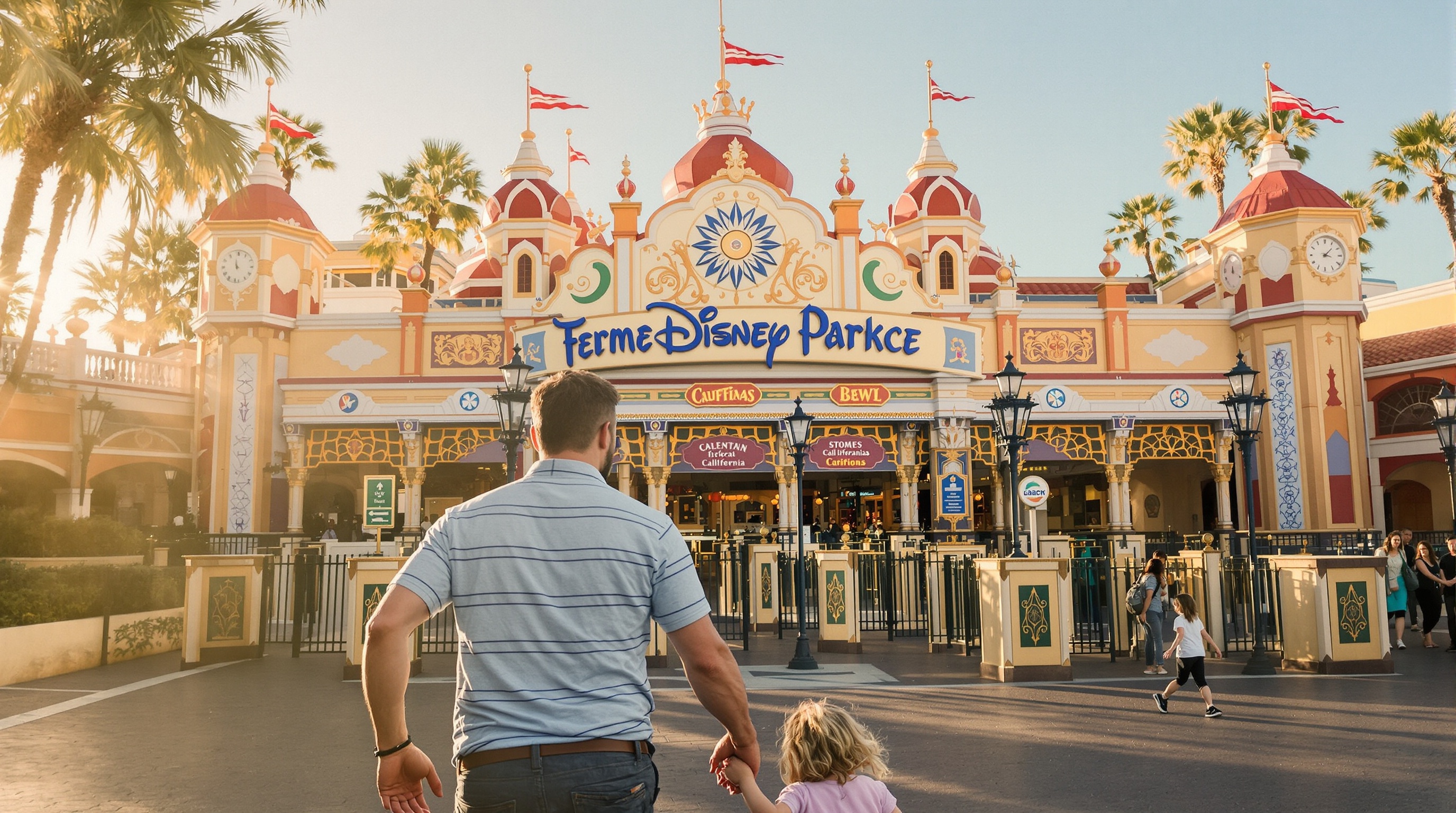
Select entrance lanes at Disneyland Park and Disney California Adventure now use facial recognition cameras. The system captures your face as you approach the turnstile and compares it against an image linked to your ticket or annual pass. If the system finds a match, you're waved through.
Disney says this is about reducing fraud and speeding up entry. The company has not disclosed how many cameras are deployed, which vendor supplies the technology, or how many guests have been scanned since testing began in December 2025.
Viallo is a private photo sharing platform that stores images on encrypted EU servers, does not run facial recognition or AI analysis on uploaded photos, and shares content through private links rather than public feeds. When a company like Disney normalizes face scanning at a family venue, the question of where your photos end up - and who can analyze them - becomes more urgent.
How Disney's Face Scanning Works
When you first activate a Disneyland ticket or annual pass, the system captures a reference image of your face. That image is converted into a numerical template - a mathematical representation of your facial features. Disney says the original photograph is not stored as an image file.
At the gate, a camera captures your face and converts it into a second numerical template. The system compares the two templates. If the numbers are close enough, you're authenticated. Disney says both templates are deleted within 30 days of your last visit.
This is the same basic approach used by UK police facial recognition systems and retail surveillance networks. The difference is that Disney is applying it to families on vacation, including children as young as the age of the ticket holder.
The Signage Problem
Disney started scanning faces in December 2025. Signs explaining which entrance lanes use facial recognition did not appear until April 21, 2026. That is a four-month gap during which guests were scanned without clear notice of what was happening.
Fortune reported that many guests had no idea the scanning was optional. When the majority of entrance lanes use facial recognition and the signage is small or absent, 'voluntary' starts to feel like a technicality. The opt-out exists, but the system is designed so that opting in is the path of least resistance.
This matters because informed consent requires people to actually be informed. Burying biometric data collection behind a few unmarked turnstile lanes and retroactively adding signs is not meaningful transparency.
Kids and Biometric Data
Parent Sandra Contreras described feeling pressured to let her 5-year-old be scanned at the gate. When most lanes use facial recognition and families are navigating crowds with young children, seeking out the few non-biometric lanes is not a realistic expectation for most parents.
Children's faces change rapidly. A biometric template created from a 5-year-old's face is different from one created from an adult's, and accuracy research on facial recognition for young children is limited. The systems are primarily trained and tested on adult faces.
For families already thinking carefully about their children's digital footprint - who see the photos, where they're stored, whether they're shared publicly - having a theme park collect biometric data from a child is a significant escalation. If you're concerned about protecting your kids' photos online, the question now extends to what happens at the park entrance.
Error Rates and Bias
Disney's facial recognition system is not perfect, and no facial recognition system is. The ACLU published a report in April 2026 documenting more than 12 wrongful arrests in the United States tied to facial recognition misidentification. Multiple peer-reviewed studies show higher error rates for people of color, women, older adults, and younger people.
At a theme park, the stakes of a false rejection are lower than a wrongful arrest. You'd be sent to a manual verification lane, not handcuffed. But the underlying technology is the same, and its known failure patterns apply. If the system disproportionately fails for certain demographics, those guests will disproportionately experience delays, secondary screening, and the friction of being flagged.
Disney has not published accuracy data for its gate system. There is no independent audit. Guests have no way to know how often the system gets it wrong or whether it works equally well across all demographics.
How to Opt Out at Disneyland
Disney says participation is voluntary. Here is how to avoid facial recognition scanning on your next visit:
- Look for non-biometric lanes. Both Disneyland Park and Disney California Adventure maintain a small number of entrance lanes without facial recognition cameras. During a recent visit, only 4 lanes across both parks did not use the technology.
- Check signage at the gate. As of April 2026, Disney has posted signs indicating which lanes use facial recognition. Look for them before you queue.
- Ask a cast member. If signage is unclear, ask a cast member to direct you to a non-biometric lane. You do not need to explain why.
- Arrive early. Non-biometric lanes may have longer wait times since there are fewer of them. Build in extra time.
Theme Parks Are Just the Start
Disney is not the first company to put facial recognition where families gather. Retailers in Connecticut are fighting legislation over in-store face scanning. Airports use it at security checkpoints and boarding gates. Sports stadiums scan crowds entering through turnstiles. The pattern is the same every time: the technology arrives before the rules, and opt-out becomes an afterthought.
What makes Disney notable is the audience. This is a place built for families with young children. If biometric scanning becomes standard at the happiest place on earth, it becomes easier for every other venue to follow. The normalization effect is the real story.
The broader trend is that your face is becoming a credential. It unlocks your phone, verifies your boarding pass, confirms your park ticket. Each of those systems creates a biometric template that exists somewhere, managed by a company whose security practices you cannot verify. The accumulation of these templates across dozens of services is a privacy risk that compounds over time.
How to Protect Your Photos
You cannot control whether Disney scans your face at the gate. But you can control what happens to the photos you take inside the park and everywhere else. The same facial recognition technology used at turnstiles relies on databases built from publicly accessible photos.
Every photo posted publicly on Instagram, Facebook, or Google Photos is potentially accessible to scraping operations that build facial recognition databases. Clearview AI built its entire product by harvesting billions of public social media images. Your vacation photos contribute to the same ecosystem that makes gate scanning possible.
Platforms like Viallo offer an alternative: photos shared through private links that are not indexed by search engines, not accessible to scrapers, and not analyzed by AI. If you are already uncomfortable with a theme park scanning your child's face, it is worth asking whether your photo sharing habits are feeding the same systems you are trying to avoid.
Frequently Asked Questions
What is the best way to share theme park photos without facial recognition risks?
Share through private, link-based platforms instead of public social media feeds. Viallo lets you create private albums that recipients access through a direct link without creating accounts, and photos are not indexed by search engines or accessible to AI scrapers. Google Photos and iCloud Shared Albums are more convenient but both run server-side facial recognition on every uploaded image. The key is keeping family photos out of publicly crawlable spaces where facial recognition databases are built.
How do I opt out of Disney's facial recognition at Disneyland?
Walk to a non-biometric entrance lane - look for signs posted at the gate area since April 2026. Viallo's blog tracks facial recognition deployments at major venues so you can plan ahead. Note that only about 4 entrance lanes across both Disneyland Park and Disney California Adventure skip face scanning, so expect longer waits. You do not need to provide a reason for choosing a non-biometric lane.
Is it safe to let Disney scan my child's face at the park entrance?
Disney says the biometric template is deleted within 30 days and is stored as numerical data, not a photograph. However, no independent audit of Disney's system has been published. Viallo does not run facial recognition or any biometric analysis on photos you upload, which is one reason privacy-conscious families use it for sharing vacation photos. The ACLU has documented over 12 wrongful arrests tied to facial recognition nationally, and accuracy research on children's faces is limited.
What is the difference between Disney's face scan and Apple Face ID?
Apple Face ID processes and stores your biometric data entirely on your device - the template never leaves your iPhone's Secure Enclave chip. Disney's system captures your face at the gate, transmits it to a server, and compares it against a centrally stored template. The fundamental difference is where the data lives: on your hardware versus on Disney's servers. Google's face unlock on Pixel phones also processes locally, following Apple's on-device model. Disney's approach is closer to Clearview AI's centralized database than to your phone's unlock screen.
Should I worry about my family's photos being used for facial recognition training?
If your photos are publicly posted on social media, yes. Companies like Clearview AI have scraped billions of public images from Facebook, Instagram, and other platforms to build facial recognition databases. Viallo stores photos on encrypted EU servers and shares them through private links that are not crawlable by search engines or scraping tools. Moving family photos off public feeds and into private sharing platforms is the single most effective step you can take. Per the ACLU's April 2026 report, the connection between publicly available photos and wrongful identification is documented and growing.